Archive for the ‘family’ Category

messy (evolution of)

Thursday, February 12th, 2009

I remember when I was about four or five and my father was trying to get me to put my things away, I finally told him that I didn’t care. If he cared, he should put them away. He called me a princess. I was confused because in the books I read, princesses were always virtuous heroines but by his tone of voice my father didn’t seem to be praising me. I tried to get him to explain but he had lost patience by then.

When I was about ten or eleven I was sitting at the dining room table working on a craft and dropped something on the floor. I was about to lean over and pick it up, when I realised that I didn’t have to. I didn’t need it right away and it was perfectly fine sitting on the floor until I did need it. All I had to do was remember where it was. This epiphany was accompanied by a worried suspicion that I was going to regret my insight.

Anyone I have lived with has, with a single exception, complained about my messiness. With that single exception, none has cheerfully accepted my other contributions to the household as adequate compensation for needing to pick up after me.

When living with that single exception, who did not, after all, pick up after me, rather the opposite, the house was so filthy that when a pregnant friend we were chatting with on the sidewalk needed to pee, we lied and said the toilet didn’t work. I think that was when I faced the fact that there was something seriously wrong. We never discussed it.

In Margaret Atwood’s The Robber Bride, there’s a scene where a pathetic, dependent character breaks something and there’s glass on the floor. This is one more contribution to a discouraging sequence of events, not because she attached value to the broken thing but because “now she would have to remember.” As in, it doesn’t occur to her to sweep up the shards; instead she will need to spend the rest of her life trying not to cut her feet by not walking in that spot. I was shocked to discover that I was a type.

For a couple of years one of my annual objectives at work in my performance review was to clean up my desk. I never really got around to doing a complete job. My boss eventually gave up. For the past four years or so my bosses have been elsewhere — Winnipeg or Mississauga or Toronto — and have not seen my desk.

It’s not that I like being messy. I don’t even like ordinary cheerful clutter; I love a stark, open, spare space. One of the first things I did upon getting a regular job was to hire a cleaning lady. It’s more that it seems too complicated. I like doing laundry, and do it diligently even if it means hauling it to a laundromat, even if it takes all weekend. Laundry is self-limiting. There is not an infinite amount of stuff that could theoretically be put into a washing machine. Once it has been washed, it needs to be folded and put away. Very simple. Not only that, I know where laundered things go. Clothes have drawers and shelves and hangers; sheets and towels have closets; dog blankets go back on dog beds; soft furnishings go back where they came from. If I start to clean a house I never know when to stop: there’s always something I didn’t get to and feel guilty about, always a decision that I don’t know how to make.

Mark determined that part of my problem is that not everything has a place to go. I feel bad when stuff is lying around in heaps, but it’s not as though changing the situation is always a simple matter of putting it in its place. There often is no place for it, so more radical intervention is called for. When he moved in he put a lot more storage in. It helps. 

Still, the other day someone said that if I were an employee, she’d fire me; that if I were a roommate, I would be out on my ass in two days. She doesn’t even know me that well. It’s just that obvious.

My boss is in town for a day. I cleaned off my desk this morning in preparation, which mostly consisted of stashing papers and the binders into which they are some day to be filed, into drawers and bins where they will be invisible to the casual visitor. Still, I feel better.

Mark has been stomping around crossly for the past few weeks, issuing dark warnings that we both need to change if we value the relationship. I’m not sure I can change, exactly. But perhaps I can put “cleaning off the dining room table every Saturday” into the same doable category as “laundry.”

Back in Liberia

Tuesday, January 20th, 2009

After returning from Bangladesh and a too-short stay with family, my father is back in Liberia.

*** *** ***
Dear Family and Friends,

Back in Liberia. I spent this afternoon with the Minister for Education and his deputies. They all say they will be up most of tomorrow night watching the inauguration and the balls. All over the world – or at least in my small sampling – people are joyful about the new direction they see in America.

My previous time in Liberia (2004), there was a short break in the war that had lasted fourteen years. My assignment took me to villages where people were rebuilding homes, shops, bridges, wells, roads, and whatever other infrastructure competing armies, often made up of children, had taken into their heads to destroy. The villages were doing their best to reintegrate their ‘lost’ young people, many of whom had done terrible things. The returnees were doing what they could to be accepted back. There were three short, intense wars in 2005, but now there is a stable and reasonably competent government headed by President Ellen Johnson Sirleaf. There is hope again… sort of. USAID is helping rebuild teacher education. Our team of three is spending six weeks to evaluate this effort and suggest improvements.

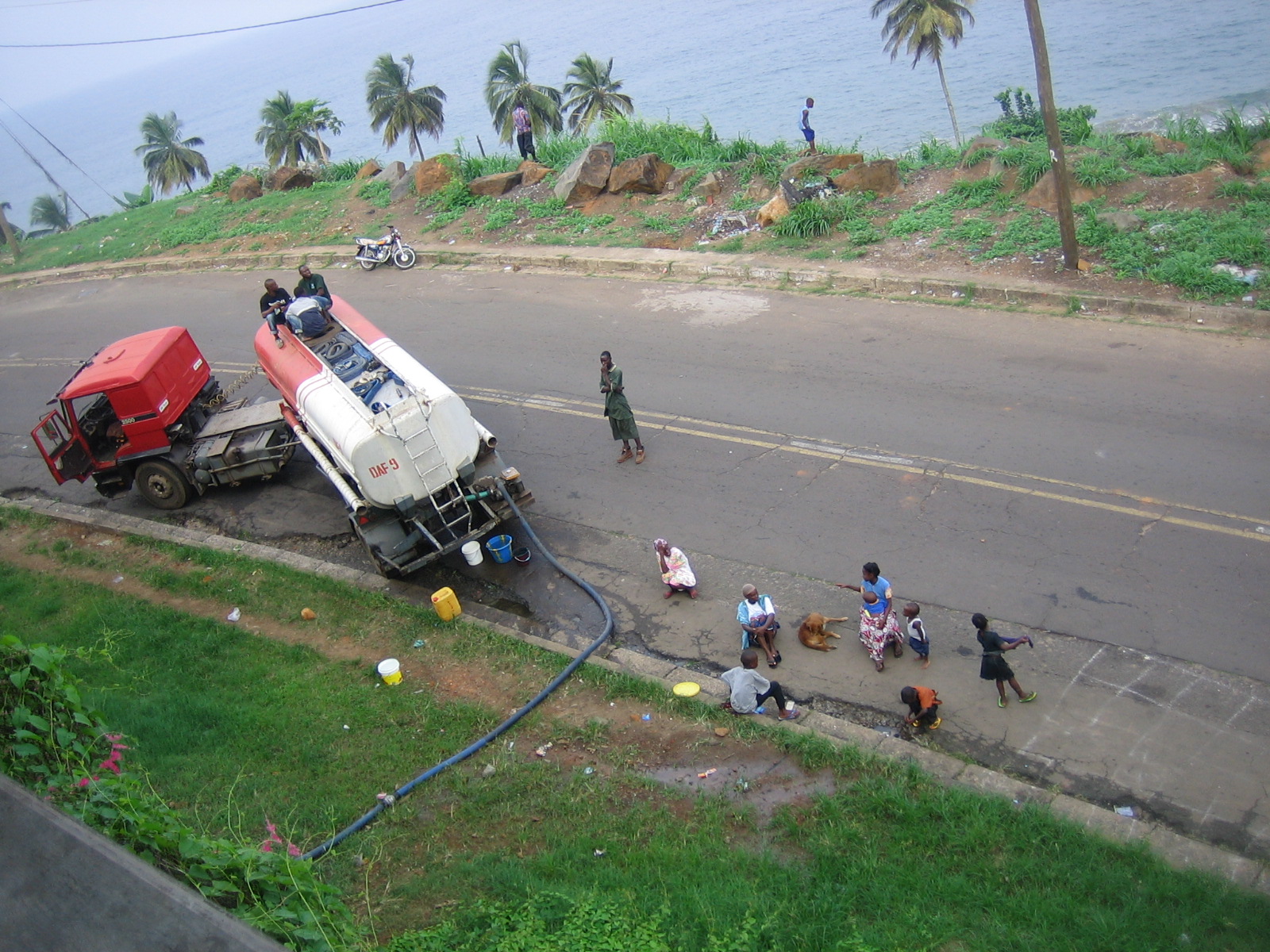
We’ve been in Monrovia since Wednesday. The attached pictures may give you some of the flavour. We’re off tomorrow for two days to see schools and teacher training colleges in the countryside. We’ll come back to sharpen our survey instruments then head back out for more intensive interviews and observations for the next four weeks.

Lunch today was cassava leaf stew with fish, chicken, and shrimp… and rice.

Update on Beli: She’s bought a rickshaw and some rice. She rents out the rickshaw and will sell the rice in small packets. Her life as a businesswoman has begun.

Affectionately,
P.

Vivian's Fashion Butik Salon

Liberia 2

Liberia 3

Liberia 4

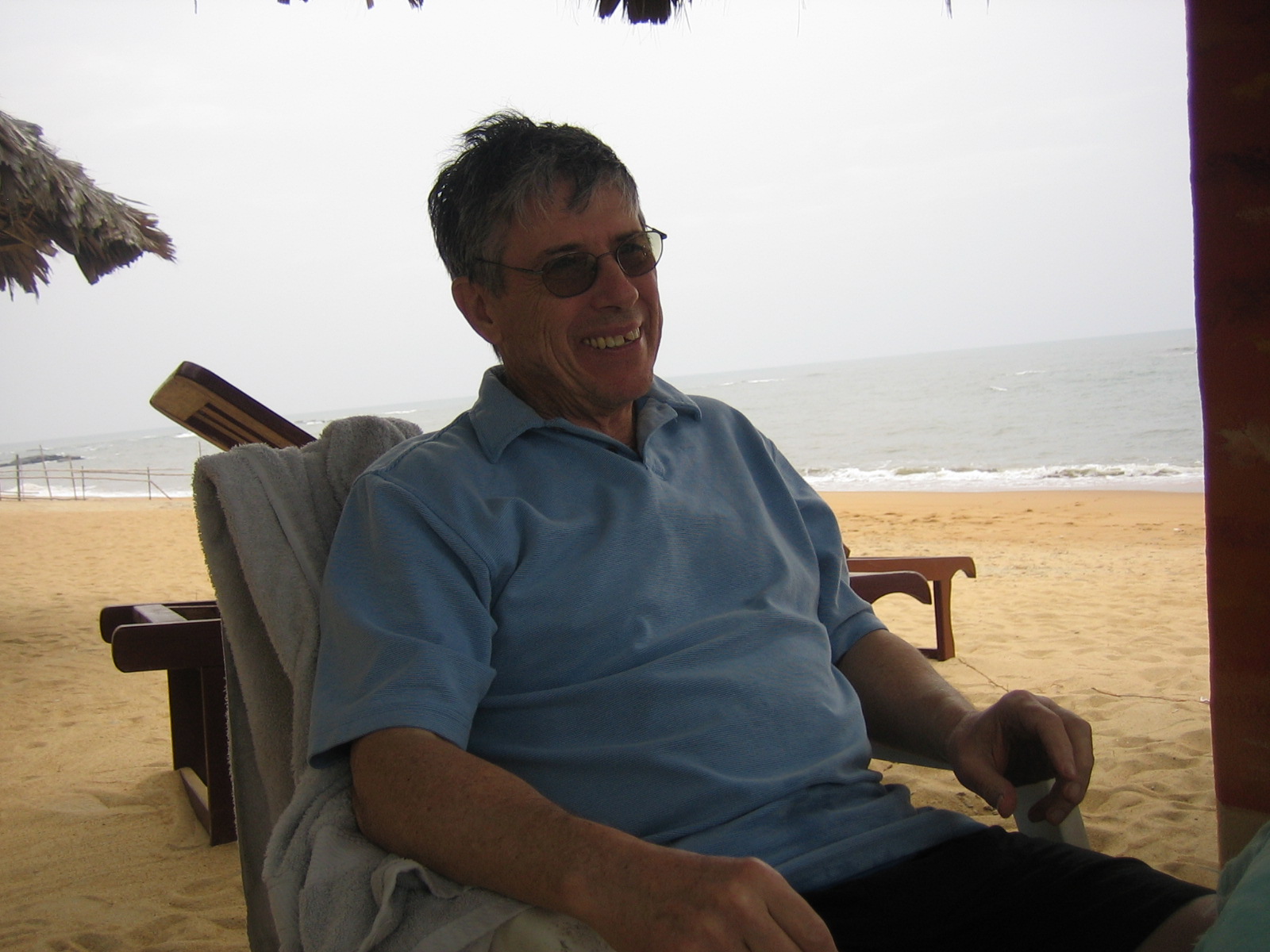
P on the beach

solace

Sunday, January 11th, 2009

I often have interesting conversations with taxi drivers, but it’s usually me who starts them.

Yesterday I gave my destination and we discussed the route. Then the driver cautiously asked me if I were Québécoise pure-laine? Well, I said, I’m anglophone but I’m born here.

Because, rushed on my driver, he had read a story in the newspaper that morning* and couldn’t stop thinking about two countries, on two continents, separated by history and religion but united in their misery. La Guinée, in Africa, and Haïti, where he was born.

He was satisfied with his life in Canada, he wanted me to know that. His children didn’t eat steak every day, but they could have meat every week. Canada is a good country, built by people who were not his parents, and he was grateful for the welcome he had been offered, the opportunity to make a life here. But he couldn’t stop looking back to his people in Haïti, feeling for their suffering.

Yes, I said, and feeling responsible but helpless and not knowing what to do. I told him I’d lived in Nigeria in the seventies when people were doing very well, that I knew a little about how people lived who didn’t have a lot of stuff, and even a little about what children looked like who didn’t have enough to eat. That I felt a bond with people in other countries and circumstances that I had no idea how to act on.

Yes, he said. One doesn’t need to have a lot of stuff to be able to care for a family. His father had been a cultivator and he had worked with him. They rotated crops with the seasons, rice and yams and vegetables. In between crops, his father fished. There was always something to do. His father had also been a judge. This was in the time of Papa Duvalier. He had disappeared one day. Both his father and his mother. The children had all found their way out of the country. It had been hard, but the children were now all over the world and managing fine. Even their cousins had left.

But now, he said, Haitian rice farmers can’t make a living any more. They can’t compete with the price of rice imported from the US, where agriculture is heavily subsidised. When rice can be bought so cheaply, people would rather buy it than grow it themselves, so they leave the farms and go to the city. But of course there is no work in the city. People struggle, women prostitute themselves.

Yes, I said, and you and I look on from our comfortable spots and don’t know what to do. I told him my father had recently returned from Bangladesh and was struggling trying to help a woman he had made friends with there. He was helping her, but it was hard. It’s hard for one person to help another person, for a country to help another country. And for one person, like him or me, to help a country – it’s very hard to know what to do.

The kind of work my parents do makes some difference directly. The kind of work I do does not. I can only donate to local and international aid organisations, but it doesn’t feel right, or like enough.

Yes, my taxi driver said, he gives to aid organisations too. To Centraide and Jeunesse au Soleil. But they’re all local.

Yes, I said, to support international aid means donating to different organisations. And then it can be hard to know if the help being offered is really useful; for instance, free american-grown rice is even worse for farmers than cheap american-grown rice. I contribute to one that gives agricultural animals. The people who receive them must commit to breeding the animals and sharing the offspring. It sounds like a good program, though I can’t be sure of its impact in practice.

My taxi driver got very excited at the thought of country people receiving such a useful and community-minded gift as breeding animals, but pointed out that it takes so much more. There has to be water, for instance. And transportation. And fertiliser. And there has to be a market.

You know, I said, we aren’t going to solve the world’s problems parked here in your taxi. But I will shake your hand and wish you a good and happy new year, and know that your frustrations are shared.

He shook my hand, and thanked me for telling him about people who work in international aid, who travel and care. He feels better now, knowing that he isn’t alone in caring.

I feel better too, knowing that I’m not alone in my lack of direction.

Happy new year to all, and may we continue to shake hands with our neighbours and share our challenges!

__________________

* That would have been these articles:

http://www.cyberpresse.ca/dossiers/crise-alimentaire/200901/10/01-816458-le-monde-de-sily.php

http://www.cyberpresse.ca/dossiers/crise-alimentaire/200901/10/01-816459-la-faim-dans-larriere-pays.php

Granddad’s 95th birthday today

Tuesday, December 9th, 2008

From a letter from my father in Bangladesh, to his children on the occasion of his own father’s 95th birthday.

*** *** ***

Today is Granddad’s 95th birthday. Ninety-five years ago many of the African Americans alive had been slaves or were the children of slaves. Granddad would have known people who had fought in the American Civil War. The First World War was about to start. When Granddad was three years old, Pancho Villa went to war with America, where little Edward was living with his parents in New Mexico. (Granddad tried to enlist to serve in the Second World War, but was rejected because they found he had tuberculosis.)

When Granddad began studying medicine, there were no antibiotics. Medicine was based in science, but was more human arts than technical. Doctors did the best they could without worrying about lawsuits. All their patients eventually died, as they do today.

In 1916, during Pancho Villa’s raid, little Edward’s mother was dying of tuberculosis. This is why they were in New Mexico. I remember overhearing Granddad telling a very young Alison about a little boy being taken in to see his mother in her bedroom. There was a candle. The light was soft and people were quiet. His heart was alive with impending and terrible loss. The little boy loved his mother very much and she loved him. Later there were women who cared for him, a Mother Superior in particular. But the room with the candle was the last time he could count on enduring love until Granny became part of his life.

When I think about Granddad, there is much I don’t understand, especially about the years when I was an impetuous boy becoming an impetuous young man. Of the things I feel I do understand, most are about love and persistence.

First of all, Granddad is and always has been a Maoist – ready and eager to learn from workers and farmers. Among his best friends in Ithaca was Charlie O’Brian, the groundskeeper. He liked to play golf, but he didn’t join the Country Club when we moved to Cortland. The parents of the children he introduced me to could not have joined. He was a member of a service club, but when they had to agree to by-laws that restricted membership by race, he resigned.

Granddad’s views on the world have never been majority views. He is not a contrarian. He is simply a man who makes judgments based on love for other human beings and on truth.

Most of my siblings know about the efforts Granddad made in respect to the Viet Nam war and about the political consciousness raising that was often part of his medical consultations. I know about these things second hand but I wasn’t in Cortland for most of that time.

What I do remember clearly is the McCarthy years, when politicians’ enemies were painted as communists and communists were painted as evil. The flavors of the times were insinuation, intimidation, and fear. Many of Granddad and Granny’s friends were ‘fellow travelers’, people who struggled for a peaceful world and a comfortable life for working people. I remember being at St. Mary’s school and being asked to pray for the Catholic, Joseph McCarthy, and his fight against godless communism. I was proud that my family knew better but horrified that other families didn’t. History has sided with Granddad on these large issues, but if millions of people hadn’t engaged as Granddad and Granny did, history might have decided otherwise. I am proud to tell people in Bangladesh that my father is publicly protesting against the war in Iraq at ninety-five.

There are many stories, many perspectives on Granddad’s life so far. You know this from sitting around with aunts and uncles and cousins at family gatherings. Let’s keep the stories alive. All of them. Granddad never tried to hide his warts. It isn’t the events themselves that are important. It’s how a life lived long and with constant effort is affecting all of us.

Love, P.

Family and Friends (Eid al-Adha)

Tuesday, December 9th, 2008

A letter from my father in Bangladesh; perhaps his last, as his work there ends next week.

*** *** ***
Dear Family and Friends,

Friends and Family who do not like to look at pictures of freshly sacrificed bulls and goats bleeding their life out into gutters (You know who you are!), should not [scroll to the images at the end of this post]. The Eid al-Adha festival commemorates God’s gift of a ram in place of Ishmael, whom God had commanded Abraham to sacrifice. In Judaism and Christianity, the child in this story is Ishmael’s brother Isaac. (Wikipedia)

The sacrificial animals began to arrive two days ago. The cattle spent yesterday on display on the street. At my last count yesterday evening there were six bulls and five goats in the parking garage. This probably means that every flat with a head of household remaining in the city had an animal to sacrifice. Not counting the foreigner.

This morning around eight o’clock, the male householders went to mosque and by nine oclock they were all on their way back home. Servants and guards had trussed the animals during mosque. The men assembled in front of their houses near the trussed animals. Hujurs (Arabic teachers) circulated, checking what looked like order books. Then the killing began. The labourers would line up an animal and hold it steady, then a Hujur would step in and with eight or ten strokes slice through the neck. Then the chief cutters begn the work of deconstruction, sending buckets of meat and bones into the garage as they were filled.

An hour or so later we heard a stampede, as hundreds of poor people with thick plastic bags swarmed into the garage. There must have been a signal that our flats were ready to distribute the one third of the meat that goes to the poor. (Another third goes to relatives, and a third is reserved for the master and his family.) Our guards lined the poor people up, then began letting them out out, each receiving a chunk of meat as they passed through the gate. Smaller swarms have been moving up and down the street all afternoon, but now seem to be heading home. There is little evidence of the carnage, except that the street has been washed. We can expect that about one third of the cattle slaughtered during the year will have been slaughtered today.

Sort of like Christmas and Halloween. Now everybody’s eating.

Affectionately, P.

baby

Wednesday, October 15th, 2008

In a comment on my last post, Susan said “I thought Pepe WAS a baby!”

Good point. He’s a prosthetic baby.

prosthesis. Dictionary.com. Dictionary.com Unabridged (v 1.1). Random House, Inc. http://dictionary.reference.com/browse/prosthesis (accessed: October 15, 2008).

1. a device, either external or implanted, that substitutes for or supplements a missing or defective part of the body.

For instance, those cool racer feet for someone who’s had their feet amputated, or saline implants for someone who’s had a mastectomy. It’s fairly obvious why someone without feet would want artificial replacements: even if they don’t look or feel like feet, you can still walk and run, which is the important part. Replacing a breast with an implant is a little less clear, because the implant carries risks, making it harder to detect any recurrence of cancer; it doesn’t look or feel like a breast; and the practical uses of an implant are subtle. I’ve thought about it though, and if I had a unilateral mastectomy I think I’d have an implant. Clothes would fit better, but also the weight on my body would be balanced and I would be less susceptible to the backaches that women with a single large breast get.

Anyway. Back to Pepe. I always wanted a large family, and I like babies. I never had the circumstances I wanted to start a family, so never did. I was always certain of my decision, but I missed the kids and babies I didn’t have. Sort of an itchy, uncomfortable feeling that had me looking for something I knew I didn’t want.

Then I got dogs. They aren’t kids or babies, but they occupy the itchy kids-and-baby spot so I can settle down and concentrate on my life instead of my itch. Kind of like a saline implant isn’t a breast, but it holds the clothes in place and allows one to head out and do the groceries without worrying about the alignment of one’s spine.