transparency

Tuesday, January 27th, 2009

Fifteen minutes.

Filed under: random — alison @ 21:09

We were fifteen minutes short of having a nice meal. Dal, rice and three kinds of vegetables. Then Mark, who had been difficult since I arrived from work, not looking at me or saying hello when I arrived, deliberately burning the rice in an effort to prove I was neglecting him, talking over the six o’clock news so I couldn’t listen, moving the beans I was cutting out of reach, complaining that there was water boiling with nothing in it, challenging me to prove we had enough pans to cook everything, commenting snidely that if I were making all this food it was clear that I wasn’t planning to wash up, putting things on the stove unasked with no idea what my plans were for them and moping when I took them off again, until finally, ostentatiously throwing out the vegetable scraps he knew I was saving, finally he achieved victory. [a moan, a reprimand] “Mark!” Confirmed in his status of injured victim, triumphantly shouted at me that I need to empty the worm composter. I turned and walked out.

We were fifteen minutes short of having a nice meal. It’s now spoiling on the stove.

Fifteen minutes.

(Mark just announced that he had sacrificed an evening out with friends to stay home with me, and that I should be displaying more gratitude. (Really, he shouldn’t have.) And pointed out that I started it.)

Saturday, January 24th, 2009

Orfeo ed Euridice

Filed under: amusements,death,movies,reality check — alison @ 18:29

Just came back from seeing a live broadcast of an opera performance at the Met. Cool use of cinema.

I cried at the beginning when Orfeo was mourning the loss of Euridice, because of the utter completeness of loss through death. And I cried when Euridice was contemplating a life loving someone who did not return her affection, because that’s what life with Mark is often like. (Euridice determined that death was preferable.)

After the opera Mark went home with somebody else, and I cried again.

Tuesday, January 20th, 2009

Back in Liberia

Filed under: Africa,family,Notes from Liberia,Patrick,US politics,war — alison @ 07:10

After returning from Bangladesh and a too-short stay with family, my father is back in Liberia.

*** *** ***
Dear Family and Friends,

Back in Liberia. I spent this afternoon with the Minister for Education and his deputies. They all say they will be up most of tomorrow night watching the inauguration and the balls. All over the world – or at least in my small sampling – people are joyful about the new direction they see in America.

My previous time in Liberia (2004), there was a short break in the war that had lasted fourteen years. My assignment took me to villages where people were rebuilding homes, shops, bridges, wells, roads, and whatever other infrastructure competing armies, often made up of children, had taken into their heads to destroy. The villages were doing their best to reintegrate their ‘lost’ young people, many of whom had done terrible things. The returnees were doing what they could to be accepted back. There were three short, intense wars in 2005, but now there is a stable and reasonably competent government headed by President Ellen Johnson Sirleaf. There is hope again… sort of. USAID is helping rebuild teacher education. Our team of three is spending six weeks to evaluate this effort and suggest improvements.

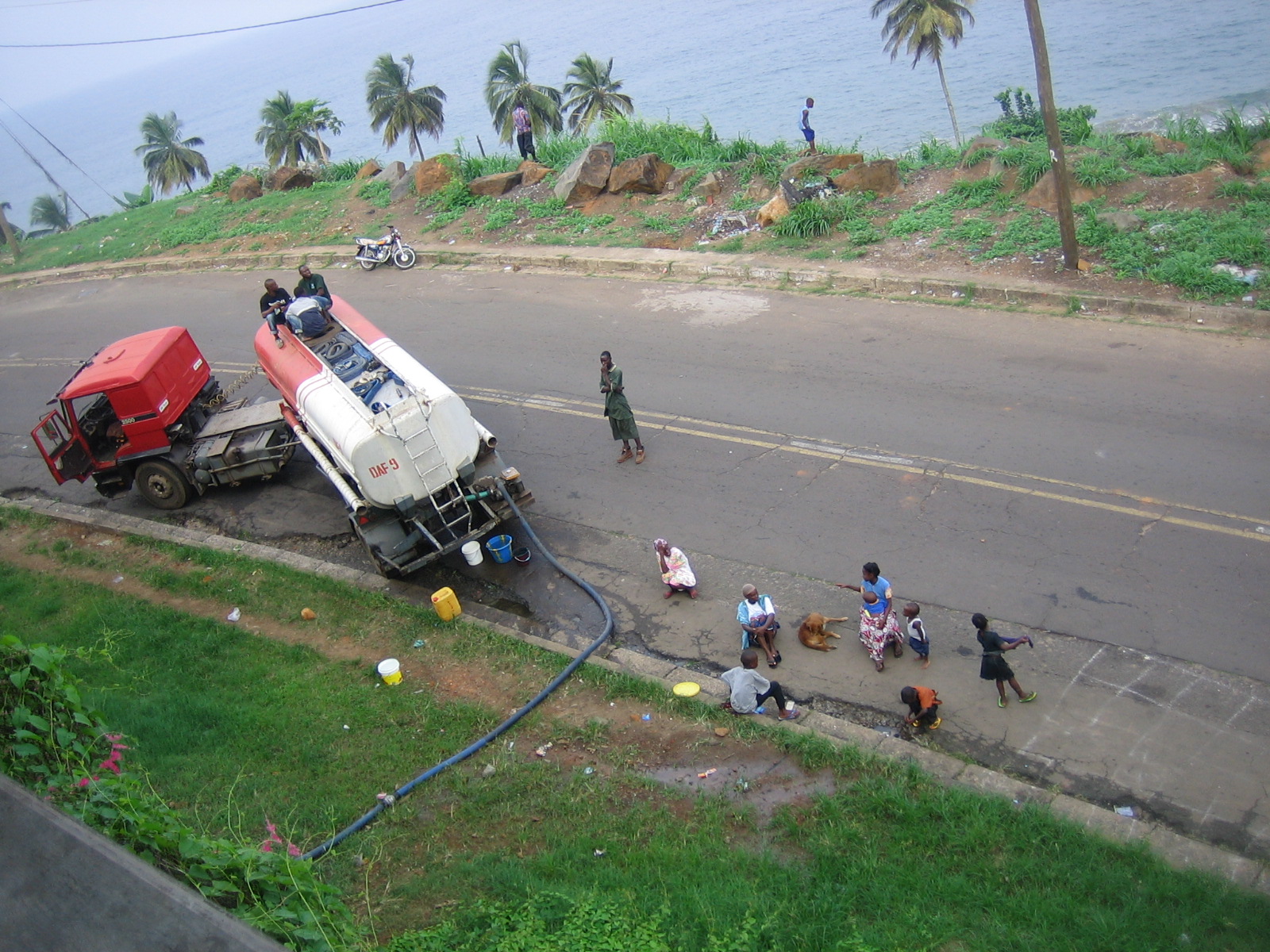
We’ve been in Monrovia since Wednesday. The attached pictures may give you some of the flavour. We’re off tomorrow for two days to see schools and teacher training colleges in the countryside. We’ll come back to sharpen our survey instruments then head back out for more intensive interviews and observations for the next four weeks.

Lunch today was cassava leaf stew with fish, chicken, and shrimp… and rice.

Update on Beli: She’s bought a rickshaw and some rice. She rents out the rickshaw and will sell the rice in small packets. Her life as a businesswoman has begun.

Affectionately,
P.

Vivian's Fashion Butik Salon

Liberia 2

Liberia 3

Liberia 4

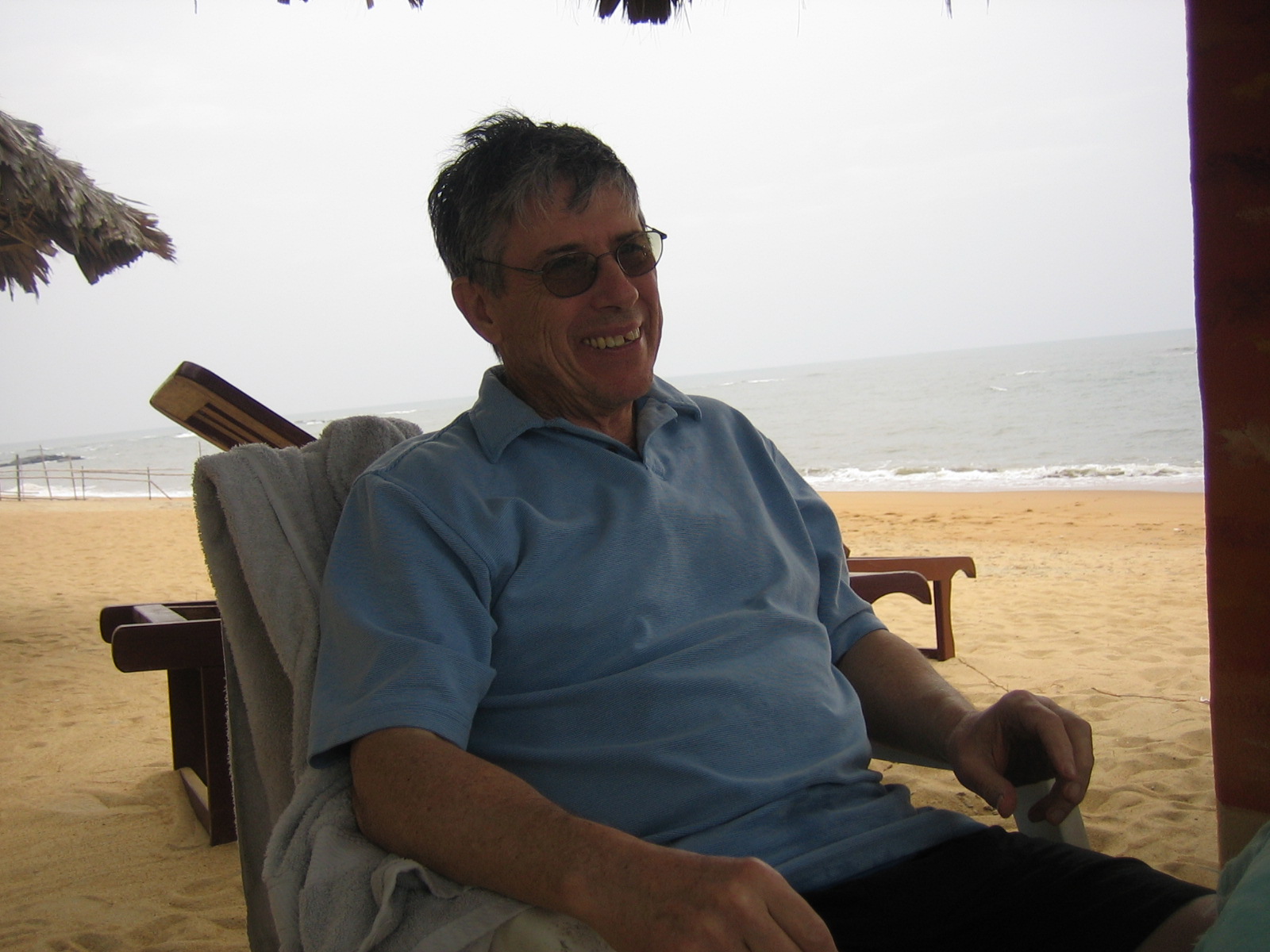
P on the beach

Monday, January 12th, 2009

solace/anti-solace

Filed under: random — alison @ 09:26

I feel uncomfortable about yesterday’s post, as if I were fishing for congratulations because I had endorsed an awareness campaign or something. Which I’m not. Yesterday’s post stands, but it’s incomplete.

So. What do people you respect actually do? As opposed to just say? I come from families of people who have set the do-ing bar rather high, which might be part of the reason I find it so hard to identify what I can do.

Mark’s citizenship preparation book suggests composting and recycling as appropriate expressions of core Canadian values, but I’ve got that covered.

Sunday, January 11th, 2009

solace

I often have interesting conversations with taxi drivers, but it’s usually me who starts them.

Yesterday I gave my destination and we discussed the route. Then the driver cautiously asked me if I were Québécoise pure-laine? Well, I said, I’m anglophone but I’m born here.

Because, rushed on my driver, he had read a story in the newspaper that morning* and couldn’t stop thinking about two countries, on two continents, separated by history and religion but united in their misery. La Guinée, in Africa, and Haïti, where he was born.

He was satisfied with his life in Canada, he wanted me to know that. His children didn’t eat steak every day, but they could have meat every week. Canada is a good country, built by people who were not his parents, and he was grateful for the welcome he had been offered, the opportunity to make a life here. But he couldn’t stop looking back to his people in Haïti, feeling for their suffering.

Yes, I said, and feeling responsible but helpless and not knowing what to do. I told him I’d lived in Nigeria in the seventies when people were doing very well, that I knew a little about how people lived who didn’t have a lot of stuff, and even a little about what children looked like who didn’t have enough to eat. That I felt a bond with people in other countries and circumstances that I had no idea how to act on.

Yes, he said. One doesn’t need to have a lot of stuff to be able to care for a family. His father had been a cultivator and he had worked with him. They rotated crops with the seasons, rice and yams and vegetables. In between crops, his father fished. There was always something to do. His father had also been a judge. This was in the time of Papa Duvalier. He had disappeared one day. Both his father and his mother. The children had all found their way out of the country. It had been hard, but the children were now all over the world and managing fine. Even their cousins had left.

But now, he said, Haitian rice farmers can’t make a living any more. They can’t compete with the price of rice imported from the US, where agriculture is heavily subsidised. When rice can be bought so cheaply, people would rather buy it than grow it themselves, so they leave the farms and go to the city. But of course there is no work in the city. People struggle, women prostitute themselves.

Yes, I said, and you and I look on from our comfortable spots and don’t know what to do. I told him my father had recently returned from Bangladesh and was struggling trying to help a woman he had made friends with there. He was helping her, but it was hard. It’s hard for one person to help another person, for a country to help another country. And for one person, like him or me, to help a country – it’s very hard to know what to do.

The kind of work my parents do makes some difference directly. The kind of work I do does not. I can only donate to local and international aid organisations, but it doesn’t feel right, or like enough.

Yes, my taxi driver said, he gives to aid organisations too. To Centraide and Jeunesse au Soleil. But they’re all local.

Yes, I said, to support international aid means donating to different organisations. And then it can be hard to know if the help being offered is really useful; for instance, free american-grown rice is even worse for farmers than cheap american-grown rice. I contribute to one that gives agricultural animals. The people who receive them must commit to breeding the animals and sharing the offspring. It sounds like a good program, though I can’t be sure of its impact in practice.

My taxi driver got very excited at the thought of country people receiving such a useful and community-minded gift as breeding animals, but pointed out that it takes so much more. There has to be water, for instance. And transportation. And fertiliser. And there has to be a market.

You know, I said, we aren’t going to solve the world’s problems parked here in your taxi. But I will shake your hand and wish you a good and happy new year, and know that your frustrations are shared.

He shook my hand, and thanked me for telling him about people who work in international aid, who travel and care. He feels better now, knowing that he isn’t alone in caring.

I feel better too, knowing that I’m not alone in my lack of direction.

Happy new year to all, and may we continue to shake hands with our neighbours and share our challenges!

__________________

* That would have been these articles:

http://www.cyberpresse.ca/dossiers/crise-alimentaire/200901/10/01-816458-le-monde-de-sily.php

http://www.cyberpresse.ca/dossiers/crise-alimentaire/200901/10/01-816459-la-faim-dans-larriere-pays.php

Saturday, January 3rd, 2009

Crap.

Filed under: business,consuming,economy,sewing,unwanted knowledge — alison @ 19:44

I went on a little stroll today to buy sewing notions. The fabric store I hit first was out of what I needed, so I headed up the Plaza St-Hubert. One of the three dressmaker supply stores on the strip had disappeared; another was closed (for the week?) and the third was open but also out of what I needed. So, onwards and upwards to the fabric stores above Jean Talon, where I found what I needed and more.

I love the Plaza. It’s four blocks of stores with glass-roofed sidewalks, known throughout Montreal as a centre for wedding dresses, white shoes, and MOBs. There are both a Salvation Army store and a Renaissance. You can get furniture overruns; $20 shoes and $300 shoes; slutty underwear and medical foundation garments; luggage; clothes for men and women, kids and grownups, skinnies and fatties; electronics; housewares and kitchen equipment; handmade items from India and Africa; sewing machines. You can mail a letter, get your legs waxed, sign up for driving lessons and send money overseas. You can duck through an alley and go to a peep show before you start work in the morning. North of the Plaza are the remains of the old needletrade sector, with fabric stores and jobbers supplying and buying from manufacturers. There’s a Vietnamese restaurant and a Roi du Smoked Meat, but it isn’t really a place for strolling and munching aimlessly; it’s for people who have a purpose.

When I first moved to the neighbourhood I found the street a bit sad, a bit soulless. In the past few years though it’s picked up, a busy place for working people. But today I noticed something had changed.

On the way down I counted:
– Between De Castelnau and Jean-Talon: two empty store fronts, one going out of business sale.
– Between Jean-Talon and Bélanger: two empty store fronts, two going out of business sales.
– Between Bélanger and St-Zotique: four empty store fronts.
– Between St-Zotique and Beaubien: one empty store front.
– Also about five signs advertising commercial space available for rent over the storefronts.

I think this is the worst I’ve ever seen on this street.

Crap.

Powered by WordPress