transparency

Monday, October 4th, 2010

Alston Adams 1974–2010

Filed under: Alston,anger,death,illness,motivational,reality check — alison @ 15:40

We met, oh, six years ago? at a YULblog meeting. He was young, social, full of life and angry. Our names sounded sort of the same. I’m the oldest of five, he was the youngest of five. He was in an interracial relationship, I’m from a mixed-race family. We had little in common but there was a feeling of kinship anyway.

Three years ago he was diagnosed with esophageal cancer.

Two weeks ago we took him for a drive in the country. We thought that sitting in the car being driven around would be about all the activity he could handle, and as it turned out we had overestimated him.

His goal was to make it to his 36th birthday, which would have been November 8th.

He didn’t make it.

You know what they say about doing whatever it is now, not putting it off because there may never be a later? Yeah. What they say.

Carpe diem.

Friday, August 13th, 2010

My goodness this has been an exciting week!

Filed under: death,Europe,excitement,family,Luc,surprises,travelling — alison @ 17:43

First my friend tweets that he thinks he may be dying,* then I hear that someone else has skin cancer,** then… Mark wins round trip tickets for two to Paris. And he invites me to go with him!
______________________________
* He’s now in the ICU but appears to be making a full and speedy recovery.
** Which is expected to be fully and speedily recovered from, but still.

Tuesday, August 10th, 2010

Twitter: messages in bottles from stranded naufragés

A very dear friend Twittered last night that he might be dying.*

Depuis 15 h, ma température est passée de 99,3 à 100,7. Je suis conscient que ma vie peut se jouer dans les heures à venir. Sentiment d’aventure…

He’s worried about the folks he’d leave behind.

Il y a des gens ici qui ont besoin de moi. Je ne dis pas émotionnellement, bien que cette dimension soit évidemment présente, mais directement, de manière très concrète, parce que leur vie est imbriquée dans la mienne. Je ne connais pas de tristesse plus profonde que ce sentiment de devoir, peut-être, abandonner ces gens qui m’ont donné leur confiance. À nouveau se battre.

He has a form of muscular dystrophy. Ten years ago he weighed 56 pounds, including the three steel rods in his spine; today he probably weighs less. He has trouble breathing because of his muscle wasting and he has just caught some sort of nasty cold from one of his staff. She was really really sick, so he is expecting to get really really sick, and when someone in his condition gets that sick they don’t always get better. He was watching his temperature go up last night and wondering whether to call an ambulance to be taken to the Montreal Chest Hospital. I’ll be making calls later this morning to find out the outcome.

He and his sister (who has the same genetic condition and lives in an adjacent apartment) do some wonderful, intensive work for people who are marginal in our society. They have employed illiterate people, drug addicts, people without family, and immigrants – particularly from Haiti. They employed me. They don’t pay much: they receive an allowance from the government to hire staff for a little over minimum wage, so the staff they hire are people who are unable to find better-paying work. They teach them french, they coach them in relationships, they explain Québec culture and help people figure out how to cope with their new situations. They have shared their living space. Whatever they can do to help someone develop their full potential. Most of all, they offer profound, unjudging friendship.

My friend is a disabled man without paid employment, but far from being a burden on society he is a householder who will leave behind people who will be poorer for his loss.

We all know he is going to die. We first met in the late eighties, when he was seventeen. He thought he might have ten years left then, for the last five of which he wouldn’t have the strength to lift a pencil. He’s outlived everyone’s expectations. But we all hope… not yet. Please.

*** *** ***
A friend responds, “What an incredible opportunity to thank him for all that he has meant to you and the world.” Wise advice, and I will follow it.

_______________________________________
* If you’re wondering why these tweets are longer than 140 characters, it’s called Twitlonger.

Monday, June 28th, 2010

Notes from Liberia – third trip

My father has just returned from another trip to Liberia. The danger pay isn’t what it used to be, but he still loves his work.

*** *** ***

Dear Family and Friends,

I came back from Liberia in early June after three weeks of field work on a mid-term evaluation for a USAID-funded education program.

Liberia is putting itself together… with help from NGOs and International Organizations whose signs are on every corner.

When I was there in 2004, there was still tension. People weren’t confident that the wars were over. Young people who had been fighters and young people who had not been fighters were uneasily moving back together in their old villages – though many former child soldiers, ashamed to return home, stayed in Monrovia, the capital, with no trades except the ones they learned in war. Market women sat in front of the home of a warlord/minister, silently holding up signs that said No More Fighting. My danger bonus was 25%.

In 2009 I visited teachers’ colleges. The students were from all fifteen of the country’s ethnic groups. You could still see wariness, but mainly they were working well together as Liberians. Ellen Johnson Sirleaf was President and was respected. My danger bonus had dropped to 15%, and applied only when I was in the countryside.

This year, the streets of Monrovia are livelier; the towns in the hinterlands are more prosperous; and ‘Ellen’ is running confidently for a second term. We once ran into a roving band of ‘commandos’ who were doing a poor job at intimidation, since they no longer carried guns. To [my wife] Vivian’s chagrin, the danger bonus had been eliminated.

I took pictures and am attaching three for flavour.
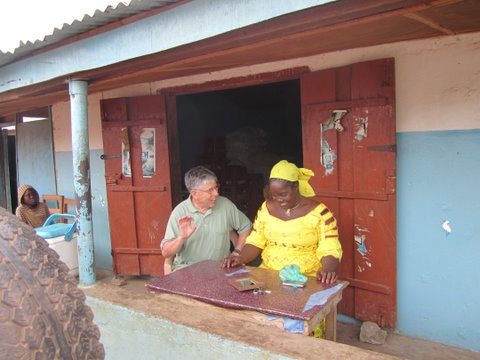
The owner of the hotel and the founder and patron of Zorzor Rural Women Literacy School.

The first is the front office of the hotel where I had just spent the night. The woman in the yellow dress is the owner of the hotel and the founder and patron of Zorzor Rural Women Literacy School. She, herself, began school after having three children. With the encouragement of her husband, she eventually earned a high school diploma.

Stop Early Marriage!

Stop Early Marriage!

The second is on a door of a mud house in a village a long way off the main road. We talked with townspeople. Different generations are back at school making up for years of lost education during the wars. Three of the young people who talked with us walk 40 kilometres to school at the beginning of the week and 40 kilometres back on the weekend. Others attend night classes at the local evangelical church. These are the survivors.

The class is full, so we know that the teacher teaches and the children learn.

The third picture speaks for itself. The class is full, so we know that the teacher teaches and the children learn. Children and parents judge the quality of schools; if the school doesn’t provide value, the children go to work on the farm.

My email misbehaved during most of the trip. When I eventually understood what was happening, Vivian hadn’t heard form me for ten days and was contacting the embassy to learn whether I was lost. Soon I started getting urgent messages saying “Please Contact your wife!” (One of the education team opposed getting involved, reasoning that I might not want my wife to know where I was. She was over-ruled.)

My assistant, Frank, and I spent three weeks, mostly on bombed-out or mudded-out roads, in a four wheel drive Toyota whose multiple breakdowns effectively randomized the communities we observed. I stayed in a different bush hotel every night, usually paying extra to have the generator turned on in the morning so I could type up the previous day’s notes. Eating was good – eggs and bread in the morning; bananas, plantain chips, and roast corn on the road; foofoo or rice and goat pepper soup in the evening. Liberia is a Christian country, so there was beer with supper. In Monrovia I ate grilled barracuda on the beach or Lebanese tabbouleh, hummus, and kibbee at a rooftop restaurant run by Indians.

In the capital, Frank found me a well-run local hotel on the main commercial strip, which I preferred to the beachfront expatriate hotels where I had previously stayed. I may have been a disappointment at the hotel, however. The first evening, while I waited for my pepper soup, the bar filled up – an attractive young woman on every second stool. Each one winked prettily as I walked out. The second night, they weren’t there.

It was a thirty-six hour trip back – through Accra, Addis Ababa, Rome, and Washington. Quicker though than the trip over, when we were diverted through Dakar to avoid the volcano in Iceland.

On my return there was two weeks of report writing – now over. And then the excitement began: First a 5.5 earthquake that felt like a ghost train running through the house. Two days later, the police invaded our quiet agricultural neighbourhood and removed plants and occupants from houses on our nearby corner.

Happy Canada Day and Fourth of July!

Pat/Patrick

Wednesday, May 5th, 2010

Plume and Poupoune together

Filed under: dogs,Plume,Poupoune — alison @ 18:18

In the park:
Plume and Poupoune in the park

At the MOC trail:
Plume and Poupone on MOC trail

Saturday, May 1st, 2010

my Jane’s Walk

Filed under: Alston,friends,Montréal,sense of place — alison @ 21:58

Today and tomorrow are Jane’s Walk days.

Jane’s Walk is a series of free neighbourhood walking tours that helps put people in touch with their environment and with each other, by bridging social and geographic gaps and creating a space for cities to discover themselves.

There are 16 official Jane’s Walks for Montreal, but I ended up improvising my own. I walked to a friend’s place, had tea, Baby Bels and good conversation about how important it is to have friends in the neighbourhood, and walked home again. It sounds banal, but it was really really nice and reminds me how good it is to have friends in your own neighbourhood – something that hasn’t been the case for me in years.

« Newer PostsOlder Posts »

Powered by WordPress